

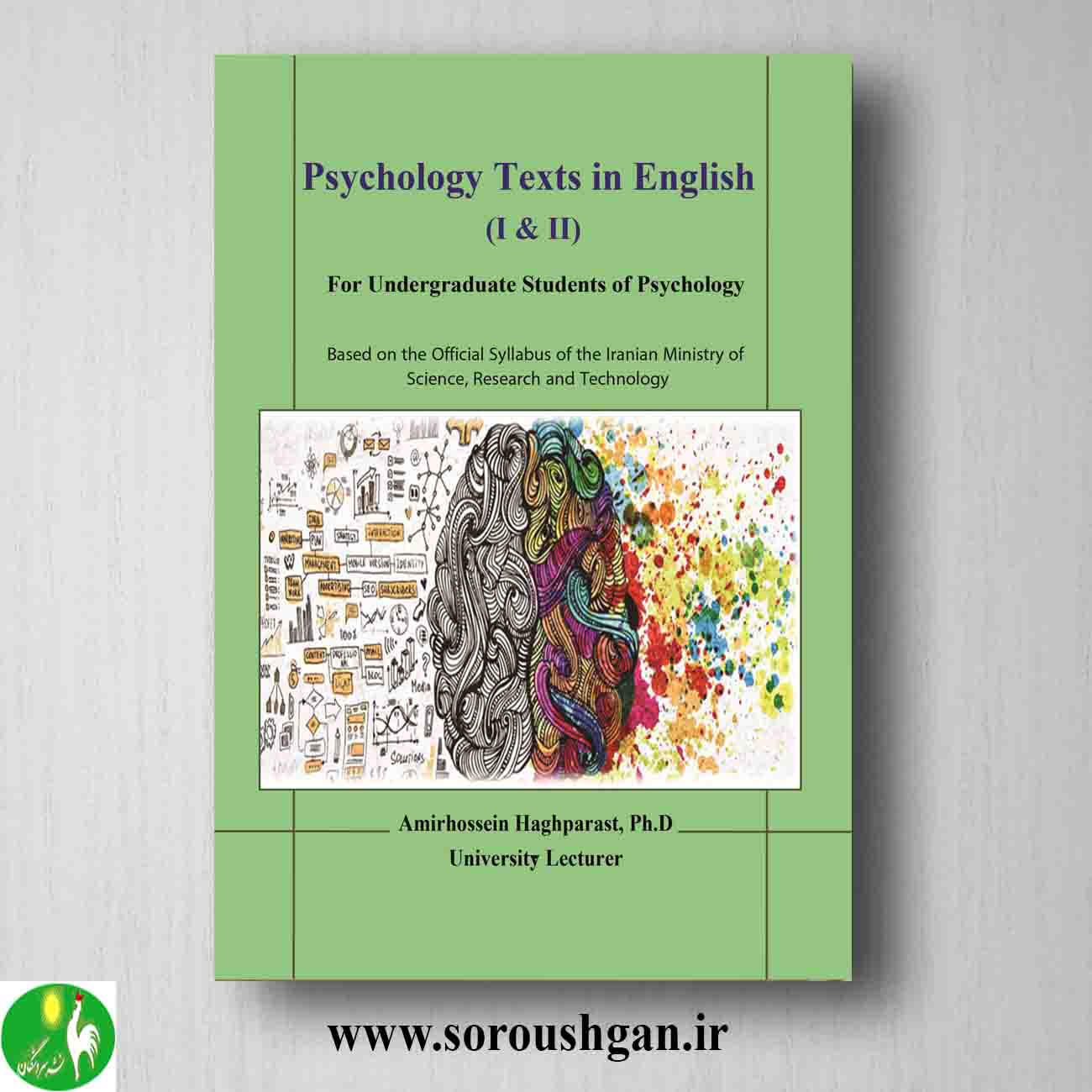
Psychology Texts in English I & II
Psychology Texts in English I & II, by Amirhossein Haghparast, Ph.D., is an academic textbook designed for undergraduate psychology students and based on the official syllabus of Iran’s Ministry of Science, Research and Technology.
Published by Soroushgan Publications, the book provides students with selected English psychology texts to strengthen their understanding of specialized terminology and academic reading skills.
Preface
This book exists to solve a specific problem. For years, I taught Psychology Texts in English 1 and 2 using existing textbooks. Again and again, I faced the same difficulty: the textbooks did not match the official syllabus.
Some topics required by the syllabus were missing. Other topics that were not in the syllabus took up valuable time. Every semester, I had to skip chapters, add my own handouts, and reorganize the material. This was inefficient for me and confusing for my students.
This book is my answer to that problem. It follows the official syllabus exactly. No topic has been added that is not required. No required topic has been omitted. What you see in the table of contents is precisely what the syllabus requires.
Who This Book Is For
This book is for first-year and second-year undergraduate students of psychology in Iranian universities. It assumes that students have completed a basic English course and are familiar with fundamental grammar and common vocabulary. It does not assume any prior knowledge of psychology. All psychological terms are explained within the texts.
What This Book Contains
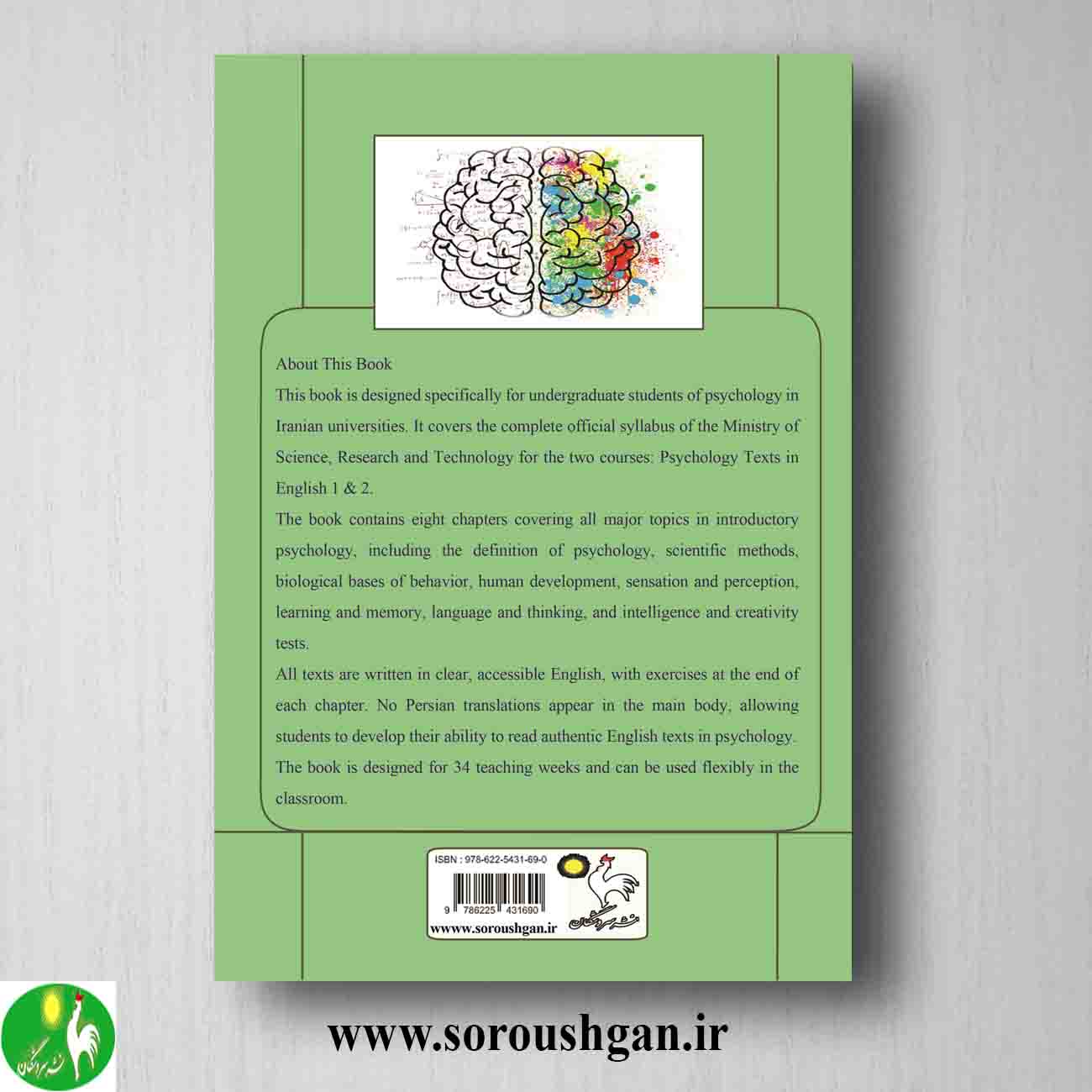
The book has eight chapters. Each chapter covers one major topic from the syllabus.
The first four chapters are typically taught in the first semester. They cover:
• Chapter 1: What is Psychology? (definition and perspectives)
• Chapter 2: Scientific Methods in Psychology
• Chapter 3: The Biological Bases of Behavior
• Chapter 4: Human Development
The remaining four chapters are typically taught in the second semester. They cover:
• Chapter 5: Sensation and Perception
• Chapter 6: Learning and Memory
• Chapter 7: Language, Thinking and Intelligence
• Chapter 8: Intelligence and Creativity Tests
What This Book Does Not Contain
This book does not contain Persian translations in the main body. This is a deliberate choice based on years of classroom experience.
When Persian translations are placed next to English sentences, students read the Persian and ignore the English. They learn very little. By keeping the main body purely English, the book forces students to struggle with the language. That struggle is where learning happens.
However, this does not mean students are abandoned to struggle alone. Instructors will provide oral explanations and translations in Persian during class. A complete English–Persian glossary is also provided at the end of the book for home study. The book provides the raw material. The instructor provides the guidance.
How This Book Was Written
The reading texts in this book are original. They were written specifically for Iranian undergraduate students. The vocabulary and sentence structures have been carefully controlled to match the level of students who have completed one or two semesters of general English.
The content is based on standard psychology sources, including those listed in the official syllabus: Hoeksema et al. (2020), Santrock (2004), Huffman (2017), and Pishghadam & Boori (2017). However, no text has been copied from any source. Every passage was written from scratch by the author.
The Time Required for This Book
The Iranian academic year for undergraduate courses is approximately 34 weeks. Psychology Texts in English 1 and 2 together occupy exactly that period.
This book is designed to fit that schedule. Chapters 1 through 4 can be taught comfortably in 17 weeks. Chapters 5 through 8 can be taught in the next 17 weeks. Each chapter requires approximately three to four sessions, depending on the pace of the class.
Instructors who meet with their students for fewer than three sessions per week may need to move faster through the material or skip some exercises. This is perfectly acceptable.
Advice to Students
You will find this book challenging at first. You will see many English words you do not know. Some sentences will be difficult to understand. This is normal. Every student feels this way at the beginning.
Do not give up. Read each text more than once. Use the glossary at the back of the book. Ask your instructor questions. The more you read, the easier it becomes.
Remember that this course is not just about psychology. It is also about English. Every text you read makes you a better reader. Every new word you learn stays with you for life.
Advice to Instructors
I wrote this book for you. I wanted to save you the time and frustration I experienced for years. With this book, you do not need to search for supplementary materials. You do not need to skip missing topics. Everything required by the syllabus is here.
Please adapt the book to your needs. If an exercise does not work for your class, skip it. If you have time for only one text per chapter, that is fine. If you prefer to add your own materials, please do so. The book is a tool. You are the teacher.
A Final Note
This book is a first edition. No book is perfect. There may be errors. Some passages may be too difficult or too easy. Future editions will improve based on feedback from instructors and students.
If you use this book and find something that needs correction or improvement, please let me know. Your feedback is not just welcome; it is essential.
Acknowledgments
I thank my mother and father for their endless love, sacrifices, and unwavering support. This book would not exist without you.
I thank my brothers for their constant encouragement and understanding throughout this long journey.
I thank my colleagues in psychology departments across Iranian universities for sharing their experiences, challenges, and practical suggestions.
I thank my students over the years. Your questions, struggles, and successes taught me what truly works in the classroom. You shaped this book more than any textbook ever could.
I thank my friends for their patience, encouragement, and belief in this project when I had little time to give.
I also thank the professors and instructors who reviewed parts of this manuscript and offered valuable feedback.
Finally, I thank everyone else who supported me along the way. Your contributions, big or small, will never be forgotten.



نقد و بررسیها
هنوز بررسیای ثبت نشده است.